Software did not trade as one AI story
In short
- Nine software stocks fell together in early 2026 on fears that AI would shrink paid seats. By October they had split: CrowdStrike and Palo Alto Networks more than doubled for the year, while Adobe lost about a third and Intuit more than half.
- The winners could show AI raising demand for what they already sell: seat growth at Atlassian, platform buying in security. Where AI was a new product to sell, as at Adobe and Salesforce, it was still around 2% of revenue.
- The next test is conversion: whether pilots at Salesforce and AI interest at ServiceNow turn into paid use once cost, data quality and governance are dealt with.
For the first half of 2026 the market traded software as a single bet against AI. The worry was simple: agents would cut the number of paid seats and let customers work around the applications they rent. All nine companies I followed fell in the first quarter, from −13% at Palo Alto Networks to −58% at Atlassian. By early October they had come apart, and the way they came apart says more than the sell-off did. The companies that could show AI raising demand for what they already sell recovered. The ones still waiting for AI to become a new line of revenue did not.
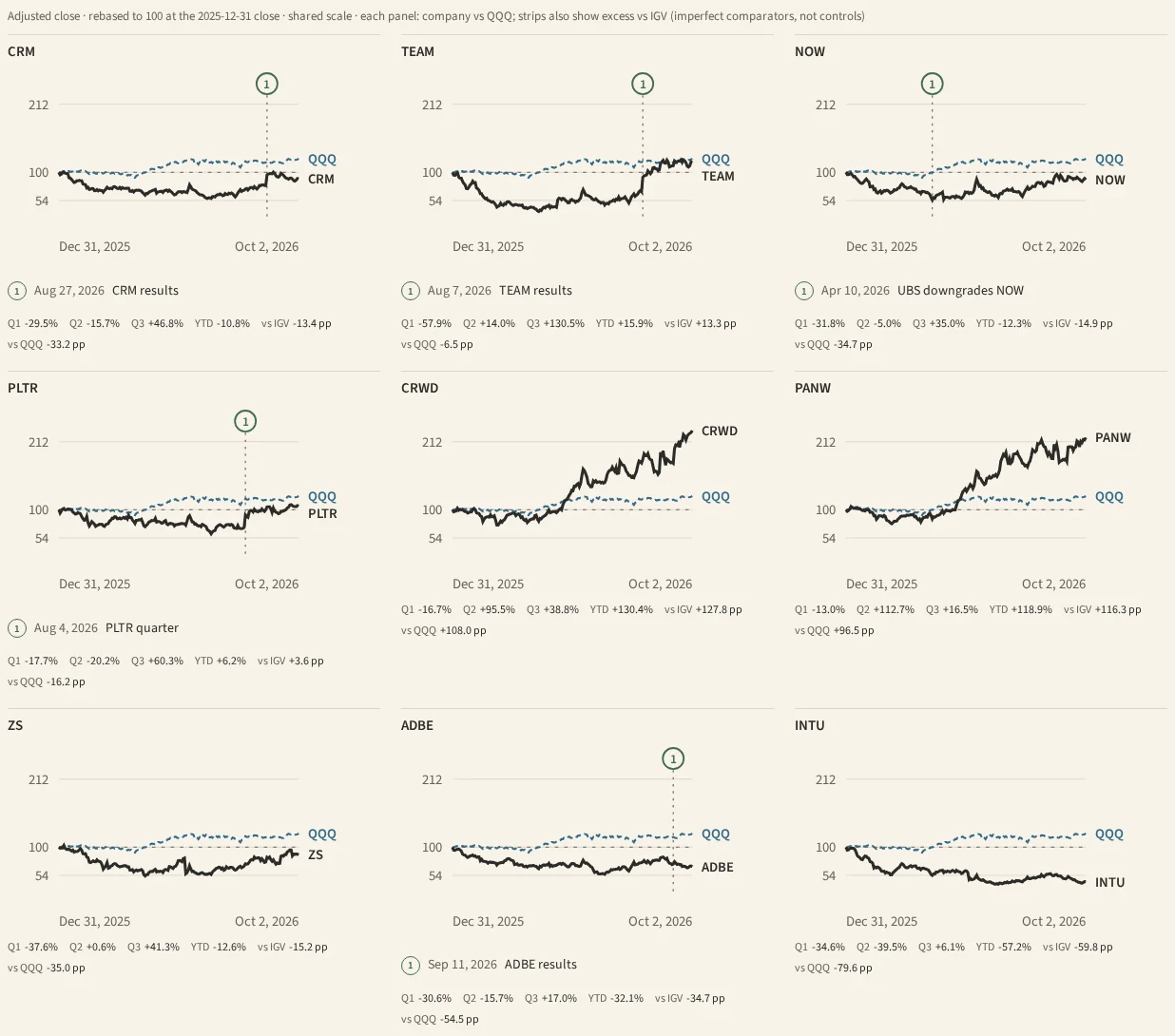
The chart sets each company against QQQ, the Nasdaq-100 fund, both at 100 at the end of 2025. Two security companies broke away: CrowdStrike finished up 130% and Palo Alto Networks up 119%, against 22% for QQQ. The third-quarter rebound was broad, with Atlassian up 131% in the quarter, Palantir 60%, Salesforce 47% and ServiceNow 35%, but it did not repair the first half. Through Oct 2 Salesforce was still down 11% for the year, ServiceNow 12% and Zscaler 13%. Atlassian (+16%) and Palantir (+6%) were positive and behind QQQ. Adobe was down 32% and Intuit 57%.
Analysts saw the split coming before the market priced it. In January Goldman Sachs rated Salesforce and ServiceNow Buy and Adobe Sell, arguing that value would collect in the software that coordinates AI agents across a company’s work. After that the calls went company by company. UBS downgraded ServiceNow in April after hearing no consistent customer commitment to it as that coordinating layer. A month later BofA rated ServiceNow Buy and Salesforce Underperform, noting that Agentforce brought in only about 2% of revenue. In security, JPMorgan argued in April that AI agents widen what attackers can reach and push customers toward large platforms, and Wells Fargo’s September checks with security chiefs pointed the same way. Morgan Stanley went the other way on Zscaler, downgrading it in April because its push beyond its core product had not caught on.
AI has helped where it made an existing product more necessary, and has not yet paid where it is a new product to sell. Atlassian is the cleanest example of the first. Its cloud growth sped up to 31% in August, and the whole cloud beat, about $49 million, came from more seats on Jira and Confluence and from bundles sold to existing customers, not from moving old customers to the cloud. That is the opposite of the seat-loss story the stock had been priced for. Security works the same way: more agents inside a company means more identities and devices to protect. After talking to Palo Alto Networks management in September, BTIG expected revenue growth above 17% next fiscal year against a consensus of 14.6%, with its AI security product rising from about $120 million of annual recurring revenue to more than $400 million. Adobe sits on the other side. Its AI-first products passed $650 million of annual recurring revenue in September, which sounds large until you see it is about 2.4% of the total, and new recurring revenue was slowing.
The constraint is not interest. It is turning interest into paid production use. The checks around Salesforce’s Dreamforce conference in September made that concrete. Oppenheimer’s customer survey found 85% had tested or deployed Agentforce, but nearly half were still in pilots. Jefferies heard that one large implementation partner saw success in only about 8% of deployments, and named pricing complexity, data readiness and decision fatigue as the hurdles. ServiceNow looked healthier on its core business: JPMorgan’s ten partner and customer conversations in early October found strong renewals and deal sizes up 10–20%. Yet the same checks found AI projects held up by the cost of running the models, data quality, governance and return-on-investment reviews, and partners described that demand as delayed rather than lost. The gap is not limited to these vendors. A BearingPoint study reported by Reuters on Oct 1 found only 13% of companies on track with their AI programs, even though nearly three-quarters reported positive financial results from them.
The worst performer has a problem AI does not fix. Intuit reset its guidance lower in August as it cut prices on its do-it-yourself tax product to win back customers. JPMorgan pointed out that online paying customers grew only 3% in fiscal 2026, down from 5%, while revenue per customer rose 15%. That is a customer-acquisition problem, not an AI one. Salesforce, down far less, has a milder version of it. Excluding its Informatica acquisition, organic growth was around 6.4–7%, and about 40% of the customers Oppenheimer surveyed keep their unified data outside Salesforce, which leaves room for data platforms or AI model companies to own the agent layer instead.
What I’m watching is conversion, company by company. At Salesforce, the share of Agentforce customers that move from pilots to paid use, and organic growth without acquisitions. At ServiceNow, whether the AI deals partners call delayed actually close. Atlassian starts usage billing on Dec 3, and Mizuho expects about 10% of cloud customers to face extra usage charges at first; that will be the first real price on its AI features. Palo Alto Networks has to turn BTIG’s forecast into its own guidance, Zscaler has a new head of sales to prove out, and Intuit needs customer additions to recover. A rebound in any of these stocks without those numbers would not tell me much.
What to watch: Whether Salesforce pilots and delayed ServiceNow AI deals turn into paid production use.