One session, two ad-tech results, two separate questions
In short
- When both reported on Aug 6, 2026, AppLovin fell 20% and Unity rose 15% in one session, while the Nasdaq-100 slipped 0.4%.
- AppLovin still grew revenue 53%, but it missed estimates for the first time since 2022 and switched its e-commerce plan from self-serve sign-ups to slower, partner-led sales.
- Unity’s ad business beat because its new targeting engine, Vector, kept taking share, as checks had shown. My view: these were two separate tests, each graded against the company’s own record.
On Aug 6, 2026, the two companies most tied to AI-driven mobile advertising reported on the same morning and went in opposite directions. AppLovin fell about 20% and Unity rose about 15%, while the market barely moved. It is tempting to read that as one AI advertising theme with a winner and a loser. I think it was two separate tests, and each company was graded against its own track record.
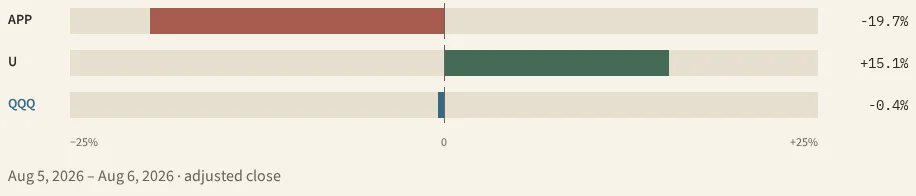
The chart shows one session, from the close on Aug 5 to the close on Aug 6. AppLovin returned −19.7%, Unity +15.1% and QQQ, the Nasdaq-100 fund, −0.4%, so AppLovin trailed the market by about 19 percentage points and Unity beat it by about 15. A single session cannot separate the advertising news from everything else in each report, so I treat the bars as the market’s verdict on the day, not as a measure of what advertising alone was worth.
The checks before the reports pointed different ways. In July BofA cut its forecasts for how many e-commerce advertisers AppLovin would sign up, while Morgan Stanley had expected self-serve sign-ups to add 200–300 non-gaming advertisers a month. For Unity, Wells Fargo raised its estimate for Vector, Unity’s rebuilt ad-targeting engine, to 15% growth over the prior quarter, and a Jefferies survey of mobile-game advertisers found Unity gaining about 2 percentage points of spending share, largely from AppLovin and smaller networks.
AppLovin was punished for breaking a pattern more than for slowing down. Revenue was $1.924 billion, up 53% from a year earlier, with a profit margin before interest, taxes, depreciation and amortization of 84%. Few companies anywhere grow like that. But revenue fell short of the $1.942 billion consensus and landed near the bottom of guidance. It was AppLovin’s first miss since 2022, after 12 to 14 quarters of beating the top of its range by about 5.5% on average, and the model upgrade investors expected had not arrived in the quarter. For a stock priced on steady self-learning gains, an in-range quarter was a bigger signal than the growth rate.
AppLovin also changed how it plans to grow e-commerce, and the number it offered in support measured something different. Instead of broad self-serve sign-ups, it will rely on partners to bring in mid-sized advertisers, which is slower. The 28% figure in the report compared consumer advertisers’ spending with their previous holiday peak; it measures spending on the platform, not AppLovin’s revenue. BofA downgraded the stock five days later and cut its 2027 growth estimate to 23% from 31%. The bull case was still coherent. Third-quarter guidance implied about 7.6% growth over the second quarter, above the usual 3–5% for the season, and RBC said after meeting management that a model upgrade had been held back for the third quarter on purpose. Both of those are promises, though, and the miss was a reported number.
Unity rose because the checks were confirmed, not because of a surprise. Its advertising business, Grow Solutions, brought in $389 million, up 35%. The figure investors watched was Strategic Grow, which leaves out the ad network and other businesses Unity is winding down: $329 million, up 63% year on year against about $306 million expected. Vector grew more than 20% in the quarter, above expectations in the high teens. Total revenue was $546 million and adjusted earnings before interest, taxes, depreciation and amortization were $160 million, 18% above forecasts. HSBC, BofA and Deutsche Bank all upgraded the stock the next day. The rest of Unity was quieter. Its game-engine business, Create Solutions, grew 2% as reported; the strategic part of it grew 5%, or 14% once a $12 million one-time item from a year earlier is excluded, and roughly met forecasts. This was an advertising quarter, not a whole-company one.
From that day, the things worth following were simple. For AppLovin, whether partners actually bring in advertisers (monthly counts of new e-commerce advertisers would ease the execution question in a way partner announcements cannot) and whether the promised model upgrade shows up in third-quarter revenue. For Unity, whether Vector keeps growing for another quarter with its revenue contribution stated, since one beat cannot show the gains will last. Shared exposure to AI advertising told you little that day. Each company’s own operating numbers told you most of what mattered.
What to watch: AppLovin’s new e-commerce advertiser counts, and a second quarter of Vector growth at Unity.