Meta’s AI products still need to earn their keep
In short
- From June 2025 to October 2026 Meta’s stock rose 0.7% while the Nasdaq-100 rose 38%. Most big moves came on spending announcements (down) or new products (up).
- AI is clearly paying off inside the ad business, where revenue grew 27% in the June quarter. Muse, the new consumer AI agent, has millions of users and no disclosed revenue.
- My view: the real question is cost. Needham counts about $628 billion of lease and purchase commitments outside the usual valuation math, and Muse has to earn more than it costs to run.
Meta is the clearest case of a market that believes in the product and doubts the bill. Over fifteen months the stock went almost nowhere while the Nasdaq-100 rose 38%, and nearly every large move in between came from one of two kinds of news. When Meta raised its spending plans, the shares fell. When it showed something people wanted to use, they jumped. The ad business underneath kept growing through all of it. What the market keeps arguing about is whether the spending around that business will earn its money back.
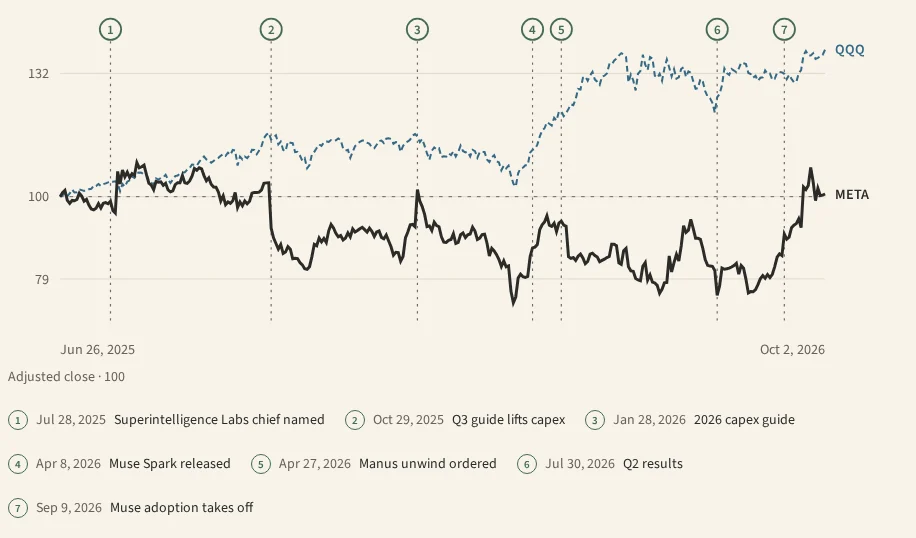
The chart sets Meta and QQQ, the Nasdaq-100 fund, to 100 on Jun 26, 2025. The first big break came on Oct 30, 2025, the day after Meta raised its capital-spending guidance: the stock fell 11.3% while QQQ fell 1.5%. The next two spending updates went opposite ways, up 10.4% after January’s results and down 8.6% after April’s. July’s results, with ad growth but higher costs, took it down another 8.0% on a day QQQ rose 3.3%. By the end of April 2026 Meta was 15.5% below where the chart starts. Then Meta launched Muse, its consumer AI agent, on Sep 9, and the stock gained 21.4% in the next two weeks, including a 12% day on Sep 21. It still ended the period up only 0.7%, against 38.0% for QQQ.
Analysts mostly agreed on the ad business and disagreed on everything else. Piper Sandler credited Meta’s new ranking models with about a 7% yearly improvement in ad conversions as early as June 2025, and Morgan Stanley made Meta a top pick in March on forecasts of 28% and 21% ad growth for 2026 and 2027. BofA put the split plainly in June: the gains from better targeting were already visible, but the returns on Meta’s frontier-model spending were not. JPMorgan upgraded the stock after Muse launched, while still modeling $243 billion and $284 billion of capital spending in 2027 and 2028 and $65–70 billion a year of pressure on free cash flow. On the skeptical side, Needham argued in July that the spending was wearing down Meta’s return on capital. Morgan Stanley, still bullish, said on Oct 1 that it expects little direct revenue from Muse before late 2027 or 2028.
Whether AI makes Meta’s ads work better is largely settled. Ad revenue grew 27% in the June quarter excluding currency effects, and the company tied the gain to its models improving conversions. Piper’s third-party data had ad prices up 33% year on year in August, and an agency budget check in late September had Meta’s third-quarter ad spending growth speeding up to 13.5–14% from 12–12.5% three months earlier. The core business is paying its way.
Whether Muse becomes a business is not settled at all. The usage evidence is strong: No. 1 in the US App Store ten days after launch, and Sensor Tower data put it past 5.1 million US downloads in 22 days, more than twice ChatGPT’s 2.3 million over its first 22 days. Then the evidence turns. An Oppenheimer survey found 8% of consumers would trust Meta with their passwords, against 30% for Google. Amazon cut Muse off from shopping on Amazon.com within two weeks, objecting that it did not identify itself. MoffettNathanson estimated that only about 11 purchases a month per consumer are realistically something an agent could handle. Oppenheimer put the bar in numbers: lifting Meta’s earnings per share by 20% would take about $27.5 billion of agent revenue, roughly 115 million people paying $20 a month.
Whether the total investment earns an adequate return is where the market is right to be cautious, because the cost side is larger than the headline capital budget. In the June quarter adjusted operating margin fell about 6 percentage points, and free cash flow was about $0.8 billion on $60.8 billion of revenue. Needham counted roughly $628 billion of obligations that sit outside the usual valuation measure: about $278 billion of signed leases that have not started yet and $350 billion of commitments Meta cannot cancel. Including them raises Meta’s valuation multiple by about 35%, by Needham’s estimate, against roughly 9% for Amazon and 3% for Alphabet. Zuckerberg described the trade-off himself in May: compute and people are Meta’s two cost centers, and more of one means less of the other. Even the model side is contested. The Financial Times reported in June that Muse Spark, the rebuilt model behind Muse, reused Llama 4 code and data and still trails rivals at coding.
What I watch is the line that connects the product to the bill. In Meta’s next results: whether ad growth matches the 13.5–14% agency check; whether any Muse revenue is disclosed (Meta said at its Connect event that it plans to take a small fee on transactions, with Shopify, Walmart and Best Buy among the first connected merchants); and whether management finally gives a 2027 spending framework, which it declined to do in July. I would also track the commitments line, since Meta signed about $68 billion more in leases in July alone. Usage growth without those numbers keeps Muse a popularity story.
What to watch: Disclosed Muse revenue and a 2027 spending plan. Morgan Stanley expects little direct Muse revenue before late 2027.