Optical demand is strong; future profits face harder tests
In short
- In a year Lumentum rose 626% and Coherent 203%, against 28% for the Nasdaq-100, on one idea: the lasers that carry AI data traffic are scarce.
- That idea has held up in results. Lumentum beat on margins in August and guided revenue about 8% above forecasts, and both companies say supply, not demand, is the limit.
- I keep it separate from the bets stacked on top (the timing of new optics packaging, Coherent’s platform push, US import limits), which are mostly forecasts and drove the sharpest swings.
The optical story has two layers, and they have behaved very differently. The bottom layer is a simple claim: the lasers that move data between AI chips are in short supply, so the few companies that make them can raise prices. That claim kept being confirmed. Stacked on top were bigger claims about new ways of packaging optics, new markets and help from trade policy. Those were priced in quickly and then questioned, and they account for most of the sharp swings in the stocks.
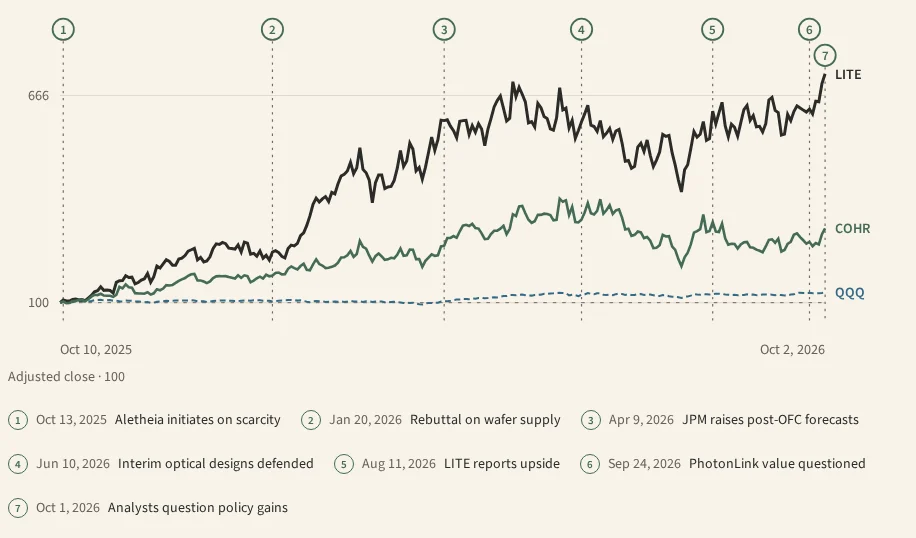
The chart sets Lumentum, Coherent and QQQ, the Nasdaq-100 fund, to 100 on Oct 10, 2025. Through Oct 2, 2026 Lumentum rose 626% and Coherent 203%, against 28% for QQQ. Most of that came early: by late May Lumentum was up about 500% and Coherent about 240%. Then the group stalled. From late May to early August Lumentum fell 14% and Coherent 24%, and by mid-June Lumentum had been roughly flat since April while chip stocks broadly rallied. August brought the sharpest back-and-forth. Both stocks rose on Aug 4 on a report of possible US limits on Chinese optical parts, fell 10–14% six days later when that report was narrowed, and then Lumentum’s results restarted the climb. From Aug 10 to Sep 23 Lumentum gained 15% while Coherent lost 8%.
Brokers built the case from scarcity up. Aletheia started coverage in October 2025 forecasting that Lumentum’s earnings per share would roughly quadruple between fiscal 2025 and 2028. In April, after the industry’s main trade show, JPMorgan raised its Lumentum target to $950 and sketched 2028 revenue near $10 billion. It also lifted its estimate of the market for co-packaged optics, where the optical parts sit in the same package as the chip, to more than $15 billion from $5 billion. Lumentum’s chief executive told Bloomberg the company expected to be sold out through 2028 within two quarters. The skeptics went after timing rather than demand. UBS expected optics inside computing racks to arrive closer to 2029. SemiAnalysis argued in June that volume production of co-packaged optics would start in 2029, not 2028. A Taiwanese trade report in September put the larger ramp in 2028–29.
The scarcity claim is the one with real evidence, because it shows up in reported margins and in what both suppliers and customers say. Lumentum’s June quarter, reported in August, beat on revenue ($1.006 billion against $990 million expected), on gross margin (50.4% against 48.8%) and on earnings. Its guidance for the next quarter was about 8% above analyst revenue forecasts and 16% above on earnings. Coherent’s management said at a JPMorgan event in late September that supply, not demand, is the limit. Stifel, after meeting Lumentum’s chief executive at the ECOC conference, reported that the company could not fully meet December-quarter demand for the lasers used in Nvidia’s systems. Mizuho said in September that indium phosphide wafers, the material these lasers are built on, remain the binding constraint, and that real relief from larger wafers is unlikely before 2028.
The packaging debate matters less for laser makers than the stock moves implied. When SemiAnalysis pushed back the co-packaged timeline, Lumentum fell 8% in a day and won back about half of it the next. But the main alternative, near-packaged optics, where the optical parts sit next to the chip rather than inside its package, still needs the same lasers. AMD said in September that its 2027 accelerator will run copper and near-packaged optics side by side, and both Citi and Bernstein argued Lumentum keeps similar laser economics either way. Where the design choice does matter is in who captures the value of the full system. That is Coherent’s bet with its PhotonLink platform, and it is where the evidence is weakest. Some investors read PhotonLink as a bundling of existing products rather than a new business, and Bernstein expects Coherent to get less margin lift than Lumentum because it makes more of its own components. That fits Coherent lagging Lumentum after August.
The policy upside is the thinnest leg. The August report of a possible US ban on Chinese optical transceivers sent Coherent up 12% and Lumentum up 9%. Within a week CLSA found that the draft rule did not target any of the ten largest transceiver makers, and the stocks gave the gains back. B. Riley called the draft a bargaining chip and noted that China controls about 70% of refined indium production. A Reuters report in late September cited research saying Coherent and Lumentum lack the scale to replace Chinese suppliers. On Oct 1 Morgan Stanley’s strategists suggested any rule would start with China-made 3.2-terabit modules and leave today’s 800-gigabit and 1.6-terabit products alone, which, as one investor pointed out, barely touches Chinese module makers in the near term.
The risk I would put first is new supply. Rosenblatt expects indium phosphide laser capacity to grow about twelvefold from 2025 to 2030, Mizuho has flagged worries about too much capacity being added worldwide, and competitors such as Source Photonics have been ramping their own lasers faster than expected. Scarcity pricing lasts only as long as demand outruns that build. So I would watch Lumentum’s next quarter against its $1.25 billion revenue guide and whether gross margin holds above 50%; Coherent’s margins on their own rather than as a read-across from Lumentum; whether laser prices keep rising, as Citi expects with another 15% increase early in 2027; and, for policy, only an adopted rule that names products and dates.
What to watch: Whether laser prices and margins hold as capacity grows, and any adopted import rule that names products.