Micron’s run: from HBM competition to what multiple the business deserves after the cycle
In short
- Capacity crowding widened the bull case: UBS saw early that expanding HBM production would crowd out conventional DDR supply, shifting Micron’s thesis from single-product share to scarcity across the broader memory complex.
- The debate moved from demand to durability: As efficiency gains, spot-price swings, and cost pressures tested the consensus, the real disagreement shifted to how long shortages last, what long-term agreements actually protect, and how much profit and cash survive after capacity catches up.
- Breadth is proven; through-cycle profitability is not: By October 2, 2026, earnings confirmed that growth extends well beyond HBM, but not that peak margins will survive a downturn. A defensible P/E rests on normalized EPS, return on invested capital, and free-cash-flow conversion — not on how high earnings reach at the top of the cycle.
In the summer of 2025, the memory debate revolved almost entirely around HBM: how large the market would grow, whose share Samsung would take once it qualified, and whether new supply would compress pricing. In July, Goldman Sachs cut its HBM market-size forecast while Morgan Stanley flagged rising competitive and pricing pressure. That framing captured AI’s most visible growth driver, but it overlooked a harder physical constraint: shared manufacturing capacity. Fiercer competition inside HBM and stronger company-wide earnings are not contradictory if shifting wafers and packaging toward HBM leaves the rest of the memory lineup starved of supply.
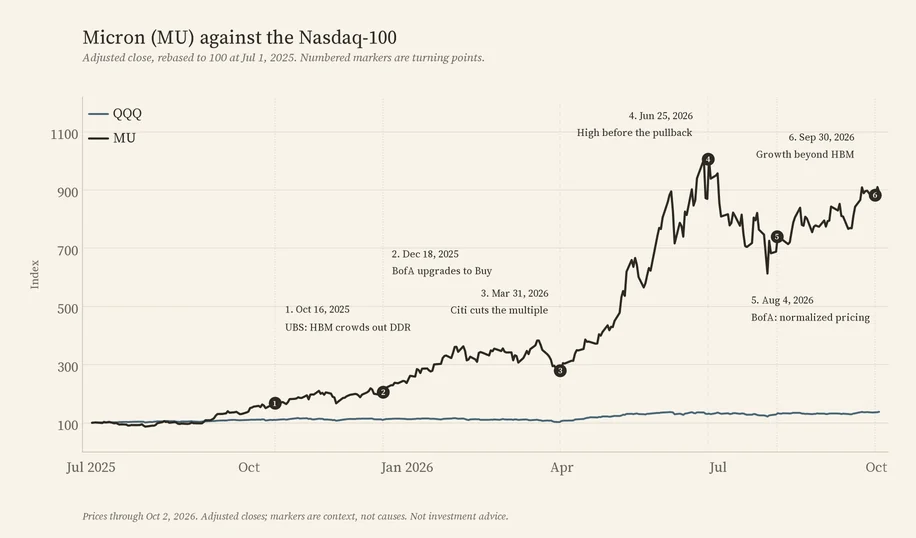
By October 2025, that transmission mechanism came into focus. On October 13, Cleveland highlighted hyperscaler demand pushing subsequent pricing higher. Three days later, UBS argued that HBM capacity allocation would tighten conventional DDR supply enough that DDR gross margins could surpass HBM’s, while Citi pointed to multi-year DRAM agreements. Among the records from that period, UBS was one of the earliest to state the mechanism plainly, and doing so changed the governing variable for Micron: the question was no longer just HBM share, but how finite capacity gets rationed and what that rationing does to pricing across the entire book. December’s earnings and guidance reinforced the point — conventional DRAM pricing rose, capacity sold out, and multi-year contracts expanded, prompting Bank of America to upgrade the stock to Buy. A durable consensus formed not because analysts kept repeating an AI story, but because supply constraints and reported numbers confirmed each other.
In March 2026, efficiency claims around TurboQuant challenged that consensus. If the same AI workload could run on less memory, would the shortage end early? Micron fell roughly 18.6% between March 24 and March 30, though no single technical paper explains a move of that size. The rebuttals on March 26 revealed that bulls were actually relying on three different mechanisms: FundaAI argued that longer context windows and higher concurrency would absorb the per-token savings; Bank of America contended that better inference ROI would unlock wider deployment and pull in NAND demand; Morgan Stanley separated KV-cache compression from total system memory and noted that supply-chain checks showed no order cuts. Those defenses cannot be collapsed into a blanket claim that “greater efficiency creates greater memory demand.” They rest separately on usage elasticity, customer budget expansion, and near-term physical bottlenecks — and if any one of those links fails, the conclusion changes.
On March 31, Citi kept its Buy rating and earnings estimates intact, yet cut its valuation multiple and price target on softening spot prices. That move isolated the real point of disagreement: the P/E multiple. Even when near-term EPS forecasts hold steady, the multiple contracts the moment investors question how long those earnings will last. The stock’s trajectory underscored how far apart a long-term demand view and a holding-period return can sit. On a split- and dividend-adjusted basis, Micron rallied 46.9% from March 27 to April 27, dropped 39.1% between June 25 and July 29, and rebounded 45.5% through October 2 — still below its prior peak. Those swings do not prove any single note right or wrong in hindsight, but they show why demand, earnings revisions, and valuation multiples have to be evaluated on separate lines.
By August, bulls had to answer what happens after the boom. On August 4, Bank of America modeled earnings sensitivity under normalized pricing; on August 7, Morgan Stanley acknowledged that price increases would decelerate and that long-term contracts do not abolish the cycle. That requires being precise about what long-term agreements actually change. Purchase commitments help a supplier plan wafer starts and smooth order visibility, but they buffer a downturn only if the contract pairs volume commitments with enforceable price floors and take-or-pay penalties. Locking in volume is not locking in price, and locking in price is not locking in margin while input costs, depreciation, and product mix keep moving. Whether Micron deserves a higher structural multiple depends on how much cyclical downside those contracts genuinely transfer to customers — not on how many years of order visibility management announces.
Once supply and demand rebalance, the next question is how much capital those profits require to maintain. Memory makers must perpetually fund lithography, node transitions, and greenfield fabs. Expanding capacity grows revenue and peak EPS, but it also raises the depreciation base and seeds the next oversupply. The quality of the business has to be judged by the return on invested capital (ROIC) it retains when conditions normalize, and by the free cash flow left over after maintenance capital expenditure. If higher earnings require proportionally larger capital outlays, scale has not improved capital efficiency; if every dollar earned in the boom must be plowed back into the next fab cycle, shareholder cash returns do not compound. “AI sells more memory” and “AI makes memory a higher-return business” are two separate claims that require separate proof.
This is where price-to-earnings multiples mislead most easily. A low P/E at the top of a cycle often just means the denominator is temporarily inflated; when earnings roll over, a cheap-looking multiple turns expensive without the share price moving a cent. Valuation has to anchor on sustainable, normalized EPS rather than capitalizing the best year of a boom — though “normalized” cannot simply be copied from a ten-year historical average if the mix of HBM, DDR, and enterprise NAND has genuinely shifted. For bulls to justify a higher through-cycle P/E, they must establish two things independently: that trough earnings will hold a higher floor than in past cycles, and that defending that floor will not consume most of the cash the business generates. A higher earnings base and a higher multiple each require their own evidence; the same “structural AI growth” argument cannot be counted twice.
Where did the evidence stand by October 2, 2026? Post-earnings analysis following the September 30 print showed that NAND drove roughly two-thirds of the revenue beat, with pricing, bit shipments, and data-center SSD demand confirming that Micron’s growth engine extends beyond HBM. That aligns with the broader cross-memory tightening UBS highlighted early on, even if a revenue beat alone does not settle the long-run margin structure of DDR or NAND. At the same time, gross-margin guidance came in below buy-side expectations, with operating expense and depreciation headwinds still visible. The bull case on demand breadth gained real support; the skepticism on margin durability remained open. What ultimately decides Micron’s multiple is how much EPS survives once prices cool and new capacity comes online, how much capital that earnings stream consumes, and how much converts into cash for shareholders. The next downturn will be the first real test of whether long-term contracts and structural mix shifts have earned Micron a permanent rerating.
What to watch: Whether trough earnings hold a higher floor, and whether defending it leaves cash for shareholders.