Memory and storage: one AI cycle, four different businesses
In short
- Through Oct 2, SK Hynix, Samsung, Micron and SanDisk were up 131% to 625% for the year, and along the way each fell 39–56% from its late-June high to its low on Jul 29 or 30, even though memory prices kept rising.
- The market trades them as one AI memory bet, but they sell different things: high-bandwidth memory for AI chips, ordinary server and phone memory, and flash storage, each with its own supply and customers.
- My view: scarcity is real across all of them for now. What separates them is high-bandwidth memory share (Samsung is gaining on SK Hynix), how much is under contract, and how much new supply each faces by 2028.
In 2026 the market treated memory as one AI trade. The four largest listed makers I follow rose together, fell together in July and recovered together, and on the worst days the moves were nearly identical. But they are not one business. AI raises demand at several levels at once: DRAM, the working memory in servers and phones; HBM, the stacked high-bandwidth DRAM that sits beside AI chips; NAND flash, used in solid-state drives; and hard drives for bulk storage. SK Hynix is mostly DRAM and HBM, with a flash business that includes Solidigm. Samsung makes DRAM, HBM and NAND flash. Micron makes the same three. SanDisk makes only flash. None of the four makes hard drives. The shared rally hid real differences in who sells what, and those differences started to show in the second half of the year.
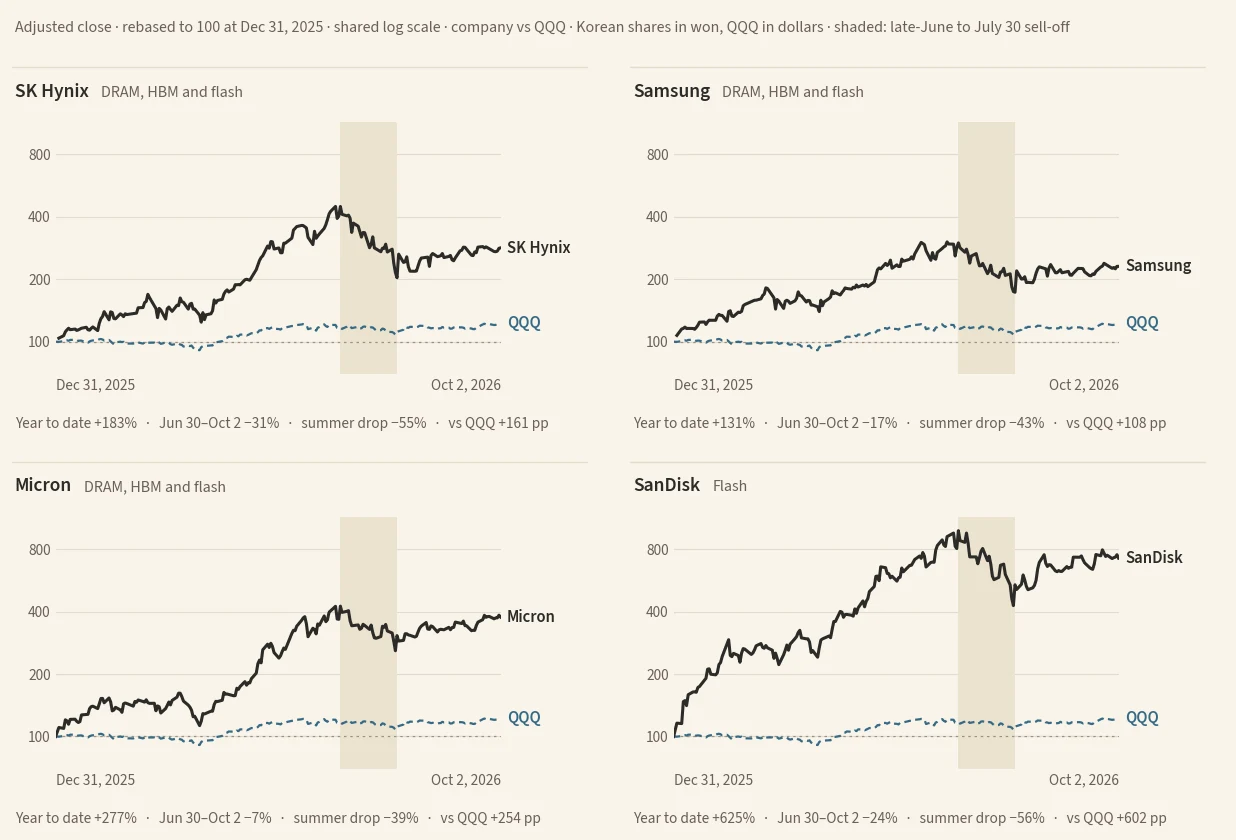
The chart sets each company and QQQ, the Nasdaq-100 fund, to 100 at the end of 2025, on a log scale so that a doubling looks the same in every panel. Through Oct 2 SanDisk was up 625%, Micron 277%, SK Hynix 183% and Samsung 131% (the Korean shares in won), against 22% for QQQ. All four peaked in late June and hit their lows on Jul 29 or 30: SanDisk fell 56%, SK Hynix 55%, Samsung 43% and Micron 39%. Three days did most of the damage. On Jul 7 Samsung’s preliminary results beat by less than investors had hoped; on Jul 13 Korea’s market fell 9%, taking SK Hynix down 15% and Samsung 11%; and on Jul 28, one of Korea’s worst sessions on record, the four fell between 9% and 15%. The rebound was uneven. From Jun 30 to Oct 2 Micron was down 7%, Samsung 17%, SanDisk 24% and SK Hynix 31%, while QQQ was up 2%.
The July drop came with almost no bad news on prices, which is why I read it as positioning more than fundamentals. Samsung’s July results still showed DRAM and flash prices rising strongly, and industry checks in late August had third-quarter memory prices finishing about 20% higher. What changed was who was holding the stocks. Situational Awareness, a hedge fund with large memory positions, was reported on Jul 30 to have sold its public portfolio to Citadel after heavy losses; that day Micron rose 18% and SanDisk 26%, and by Aug 4 markets were back where they had been before the unwind began.
Analysts mostly agreed on demand and argued about how long it lasts. JPMorgan, starting coverage of SK Hynix in September, called the cycle mid-stage, with more than half of SK Hynix’s capacity under long-term agreements and earnings per share growing about 34% a year through 2027. UBS raised its third-quarter DRAM price forecast to +23%, above the roughly 18% consensus. Evercore argued that AI agents, which keep their working state in memory, raise demand across every tier at once. Bernstein took the longer view: shortages of ordinary memory through 2027, then more capacity and limits on AI budgets bringing prices down in 2028, with supplier gross margins falling from around 90% at the peak toward the high 70s. Through September the bears’ main worries were that price increases were slowing and that Chinese supply was coming.
High-bandwidth memory is what divides the suppliers, and the share is moving. Bernstein’s tracking of Korean exports in July implied Samsung’s HBM revenue could rise about 80% in the third quarter while SK Hynix’s fell about 20%, which it put down to delayed shipments of the newest generation, HBM4, for Nvidia’s Rubin chips rather than weaker demand. Samsung’s HBM4 yields were reported to have climbed to about 80% from 60% at the start of production, it expected third-quarter HBM4 revenue to more than triple, and on Oct 2 it was reported to be asking mid-to-high $4 per gigabit for HBM4 in 2027, against about $1.50 for the previous generation. Micron said most of its 2027 HBM supply is already contracted at significantly higher prices and that it is co-developing a custom HBM4E with Nvidia. That shift fits the chart: SK Hynix, which had led the HBM market, had the weakest second half of the four. It also cuts both ways for the group. Bernstein trimmed its 2027 HBM price forecast because more competition means HBM may end up less profitable than ordinary DRAM.
The scarcity is broad right now because HBM eats capacity. HBM needs more than three times the wafer capacity of ordinary DRAM for the same number of bits, and Samsung expects it to take nearly 30% of the industry’s DRAM wafers in 2027, up from about 20%. That squeezes the ordinary memory everyone else buys. Micron’s results on Oct 1 showed it clearly: flash prices rose about 30% in the quarter against about 20% expected, and flash drove two-thirds of the revenue beat. So the flash-heavy names are not riding on someone else’s AI story; they are getting the overflow. The limit is the customer. Kioxia’s chief executive told his sales team in September not to push steep price increases on data-center buyers because their budgets are finite, Micron flagged that PC and smartphone unit sales could fall by double digits in 2026, and fourth-quarter price increases were tracking 5–10%, well below the third quarter’s.
Contracts and buybacks change the shape of this cycle. New supply is coming, and it lands unevenly. More of each company’s output is now committed: over half of SK Hynix’s capacity, according to JPMorgan; more than 75% of Micron’s 2027 output, with long-term agreements covering over 35% of its expected revenue through 2030, most of them with price ceilings as well as floors; and half of SanDisk’s flash this fiscal year, rising to two-thirds in fiscal 2028, at about 80% gross margin at the price floor. The companies are also handing cash back: SK Hynix announced a new buyback in August and committed to return more than half of its 2025–27 free cash flow, and SanDisk put $4.5 billion of a $5 billion quarter of free cash flow into buybacks. The supply side differs by company and product. SK Hynix is expanding its flash plant in Dalian by about 50%, and talks reported in September about making memory with Intel in the US by 2030 knocked the whole group down. Micron’s capital spending will rise more than 80% next fiscal year, mostly on clean rooms usable from late 2028. In China, CXMT, which listed in Shanghai in July, reached 10% of global DRAM in the June quarter, and YMTC is preparing a roughly $5 billion listing with the aim of leading the flash market by the end of 2027.
So I would stop asking whether memory is in a good cycle and ask which part of it each company sells. For the October reports I would watch the pace of price increases after the third quarter’s roughly 20%; who wins HBM4 volume at Nvidia, and whether SK Hynix catches up later this year as Bernstein expects; whether customers accept Samsung’s HBM4 premium; how much of each company’s output sits under contracts with price floors; and every new supply announcement, from CXMT’s high-bandwidth memory qualification to YMTC’s listing and any SK Hynix plant in the US. Shared demand does not mean equal returns.
What to watch: Whether price increases keep slowing after about +20% in the third quarter, and who wins HBM4 share at Nvidia.