AI spending: four companies, different paths to payback
In short
- Alphabet, Microsoft, Amazon and Meta all trailed the Nasdaq-100 from January to October 2026, even as their cloud businesses grew 37–82%.
- Their cash positions are far apart. In the June quarter Microsoft had about $20 billion of operating cash left after capital spending; Alphabet and Amazon spent more than they brought in.
- My view: Microsoft’s cash and Amazon’s pricing power are the strongest evidence. Alphabet’s payback is still a management claim, and Meta’s depends on revenue it hasn’t reported yet.
By the middle of 2026 the question about the four largest AI spenders had moved from whether demand was real to whether the spending turns into cash. Their cloud and ad businesses grew quickly all year, and all four still lagged the Nasdaq-100. Put their June-quarter filings side by side and part of the reason is plain: they are spending at very different rates relative to what their businesses bring in, and growth alone has not been enough to win the market over.
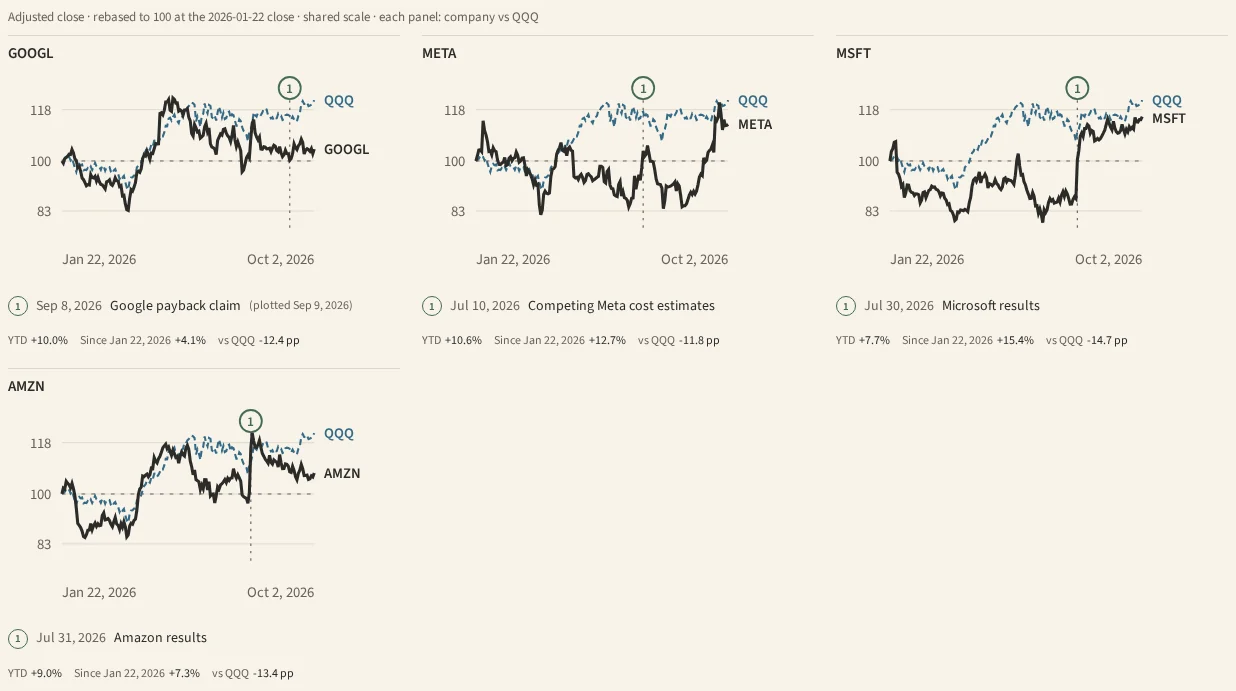
Each panel sets one company and QQQ, the Nasdaq-100 fund, to 100 on Jan 22, 2026. Through Oct 2 QQQ rose 21.2%. Microsoft rose 15.4%, Meta 12.7%, Amazon 7.3% and Alphabet 4.1%, so all four trailed. Each had a deep fall along the way: Meta dropped 29% from late January to late March, Microsoft 26% from late January to late June, Alphabet 21% from mid-May to late July and Amazon 19% in the first weeks of February. The low point in sentiment came in June, when free cash flow, returns and the chance of share sales to fund the build-out were the main worries. July’s results, with faster cloud growth and much more talk about return on investment, started the recovery for Microsoft and Amazon.
Early in the year analysts mostly raised forecasts. Wolfe lifted its 2026 growth estimates for Amazon Web Services and Google Cloud in January, and TD Cowen argued in March that Amazon’s revenue per dollar of capital spending would recover toward historical levels by 2028. By late May the tone had changed: the companies themselves were saying capital spending was rising mainly because components cost more, not because they were adding that much more computing. In the fall the checks split by company. Citi saw Google’s new Gemini model improving its product prospects at low introductory prices. Wells Fargo expected Microsoft’s Azure growth to beat guidance but left its margin and cash-flow estimates almost unchanged, and reported Amazon raising its prices for reserved chip capacity again. Morgan Stanley expected little direct revenue from Meta’s new Muse agent until late 2027, and Needham argued Meta’s off-balance-sheet commitments make it much more expensive than standard measures show.
The cash positions are far apart. In the June quarter Microsoft generated $55.4 billion of operating cash and spent $35.8 billion on property and equipment, leaving about $20 billion. Meta was roughly even, with $31.9 billion in and $30.1 billion out. Alphabet spent about $6 billion more than its operating cash flow, and Amazon about $9 billion more. These are company-wide numbers, not returns on AI specifically, but they show who is paying for the build-out from current business and who is not. Growth rates do not sort them the same way. Google Cloud grew 82% with a 36% operating margin. Amazon Web Services grew 37% with a 39% margin, a figure that includes $0.6 billion of non-cash gains on energy contracts. Azure grew 43%, and Microsoft does not disclose its profit.
Pricing shows who has the stronger hand with customers. Amazon raised its prices for reserved GPU capacity for the fourth quarter in a row in October, by 15% on top of 20% in July, for a total increase of about 40–75% this year depending on the chip. That says demand is still ahead of supply, though contracted capacity means the revenue arrives with a lag. Microsoft, by contrast, is paying for some of its growth: Wells Fargo’s checks found it discounting Copilot seats to secure customers’ commitments to spend on Azure. Google is using price to win share. Citi noted that its new model’s introductory price of $2 per million input tokens is well below the roughly $10 frontier competitors charge.
More spending is not the same as more capacity, and financing is starting to blur the cost. If component inflation drives much of the rise in capital spending, each dollar buys less computing, which pushes payback further out; third-party checks in September also showed Amazon’s and Microsoft’s capacity growth slowing from August. Meanwhile some of the cost is moving onto other lines. The Financial Times reported Amazon in talks to sell about $8 billion of already-installed Nvidia chips to an outside-funded vehicle and lease them back, as it heads toward about $220 billion of capital spending this year. Needham counted roughly $628 billion of Meta obligations that standard valuation leaves out. Microsoft’s apparent cut to its 2026 spending figure in July turned out to be mostly an accounting reclassification. Google Cloud’s chief executive says AI servers pay for themselves in under two years, but that is management’s estimate, not something the filings show.
So when these companies report the September quarter, I would look past cloud growth to three things: operating cash flow minus capital spending, new lease and purchase commitments, and whether Amazon’s price increases show up in revenue. Until the companies disclose revenue and profit tied to their AI investments, I don’t think there is a defensible single winner on AI returns, only different amounts of evidence. Today Microsoft’s cash and Amazon’s pricing are the strongest. Alphabet’s product momentum is promising but its payback is still a claim. Meta’s case rests most on revenue it has not yet reported.
What to watch: Operating cash minus capital spending, and new lease commitments, in the September-quarter reports.